








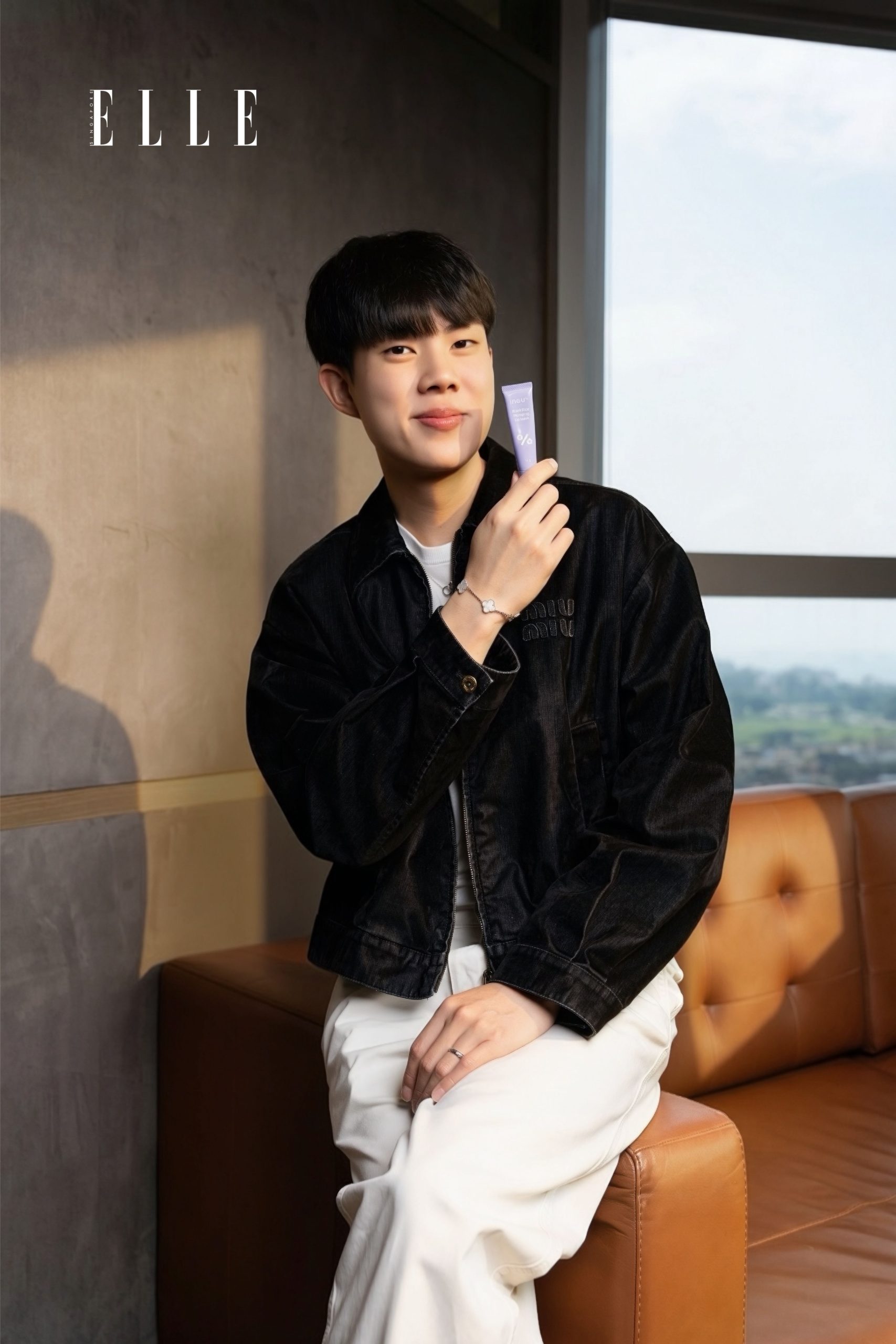
If your social media algorithm is even remotely skincare-focused, chances are you've come across Chayadhorn "Ing" Kitiyadisai. The beauty creator and founder of viral Thai skincare brand INGU Skin has built a devoted following with his infectious personality and knack for breaking down complex skincare ingredients into engaging, bite-sized lessons. For Ing, making cosmetic science approachable is more than just content—it's part of a broader mission to educate consumers and democratise the knowledge behind today's most talked-about skincare products and ingredients.
Ing's personal journey with skincare began at a young age, spurred by persistent issues with acne that plagued him through his school days. Like many others, he looked to trending products for a quick fix, and often found them ineffective for his long-term skin health. He began rethinking his approach to skincare after a particularly unpleasant experience, when his usage of a popular BHA product caused his skin to become inflamed. This pushed him to simplify his routine and, after a few weeks, gave him the best skin of his life. "It made me realise that our skin doesn’t need too much, but people—including myself at the time—were conditioned by the marketing and noise in the market," he said. This line of thinking influenced his educational content as a beauty creator and later, the formulations for INGU Skin. "The skin is a really smart organ. It doesn't need that much to function."
Related article: Noble Panacea's Céline Talabaza On Why Skincare Should Sync With Your Circadian Rhythm
Long-time viewers of Ing's would know that his family has a long history in the cosmetics manufacturing space. Across his career as a content creator, he also spent time in labs with his relatives learning the trade and took formulating classes on weekends. Over time, he realised that he had the unique opportunity to actualise the values that he had been preaching on his YouTube channel into products that would help his viewers along on their skincare journeys. "I think that’s why it was successful from day one, because it was such a seamless transition within the same universe," he said.
While he was in town for an INGU Skin pop-up, ELLE Singapore sat down with Ing to discuss his philosophy as a creator and brand founder, the future of Thai beauty and to share his biggest skincare tips for our Southeast Asian climate.
What is the INGU Skin philosophy?
Our logo has a percentage symbol at the end, and if you zoom into it, you’ll see that it’s a pentagon instead of a circle. It stands for our five values. Simplicity, because I think skincare should be simple. Transparency is also very big for us, because I come from a clinical testing background. We want to make science easy to understand. That’s why we bring our ingredients to the front of the box. The third value is empowering local producers. We knew from day one that we wanted to make INGU a global brand, and we use local ingredients paired with internationally recognised ones, like niacinamides and ceramides. We go to the farmers, extract the ingredients and perform clinical research with local universities.
Our fourth value is facts without fear. Going against fear-mongering in the beauty industry. I’m sure you’ve heard of labels like paraben-free, silicone-free and alcohol-free. There’s a movement of brands demonising certain ingredients in order to sell their own stuff as alternatives. I’m against that, because if you look at the science, you’ll know that parabens are some of the safest preservatives. Silicones are very safe, and have a very low risk of irritation. Alcohol, there are a hundred different types. It all depends on dosage, so we want to communicate transparent, honest science.
Our final value is realistic sustainability. I say realistic, because I hate when the beauty industry greenwashes things. For example, glass packaging is marketed as eco-friendly, yet the weight of glass increases the carbon footprint in transportation. Or natural essential oil extracts; people think it’s good, since it’s natural. But you’d have to grow thousands of roses, for example, to get just a few millilitres of rose essential oil. That’s terrible for the world. We’re trying to educate consumers on what brands should be doing, not just saying to make the world a better place. All of our packaging is made from post-consumer recycled plastic, because recycling in Thailand is terrible. Nobody recycles in Thailand, so at least we’ve recycled the materials used in our packaging once at the beginning of its life cycle. Even if people trash it after, we’ve already recycled it once. We’re adapting to the local culture in terms of sustainability.
Related article: 12 Easy Beauty Resolutions To Make In 2026, From Mindful Skincare To Micro Meditations
You talked about highlighting local ingredients. How does that process, from deciding what ingredients to use to bringing it from concept to production, usually go?
We look at the medical literature first. Our formulas are focused on being climate adaptive for people within the region, because we deal with humidity, heat, UV and pollution. These problems are creating specific skin concerns. Pigmentation, oily skin, congestion, wrinkles and fine lines are huge issues for Southeast Asians, so we try to find out what ingredients we have here that could help with the skin problems that arise from our climate.
Then, we go to local universities to see what they’re doing, and see if professors have identified specific local plants that have promising results. The thing with universities, they do it for the thesis. So, we come in with the resources and funding to help them research on a larger scale, enabling us to mass produce it. Take our green tea line, for instance. I knew that Thailand had really good green tea in the north, but no one has really used it for skincare. So, we called up Mae Fah Luang University, which is a famous university in Northern Thailand. They have a department specialising in tea and coffee, and I asked a professor about the best green tea in Thailand. He directed me to a rural farm near the border of Myanmar, which produced green tea with the highest antioxidant levels. We went up there to collect samples to research in our Bangkok lab and found that the antioxidant levels—which help reduce inflammation—was as high, if not higher than the Japanese, Korean and Chinese green tea the world already knew about, because these trees were three, four stories high, unlike the typical green tea trees you’d imagine. They are local Assamica trees that have been there for hundreds of years, so that's why they have such high antioxidant levels.
We have so many examples of these stories through the ten different natural extracts that we work with across all our products. That being said, I don’t want our brand to present to the world as being exotic, herbal, or oriental, because that’s how foreigners have viewed Thai or Asian skincare in general for so long. That’s why we pair them with international innovation, so that it becomes a synergistic story, and we're able to convey our honesty and transparency, our other values, and not be boxed into the exoticism of Asian beauty.
Related article: Exclusive: Allies Of Skin's Nicolas Travis On Rewriting The Skincare Playbook
Tell us about the challenges you’ve faced starting INGU Skin.
I call myself a nepo baby, but it’s not easy at times. I came from a content background before launching the brand, so that came with many challenges with how people perceived me in the beginning. There’s this idea that I’d cashed out talking smack about competitors before starting my own brand, so it took a while to change the perception of some people. They might be a minority, but we do get questions about our honesty and transparency. What I’ve proven the last few years is that promoting the entire Thai cosmetic industry, not just my own brand, lobbying for stronger manufacturing and product testing laws can help all of us. In the past year I’ve been making content in English, many people have realised that I actually am trying to make T-Beauty a thing. A big challenge was transitioning from content creator to brand owner in a way that’s still honest, making sure people understand my values and that I’m not just here to cash out.
Was highlighting Thai beauty always important to you, or was it something you realised as you built your brand?
It has always been important to me, because my family has been manufacturing cosmetics for some of the biggest brands in the world for over 70 years—but my grandparents and parents were never able to proudly claim that the product was made in Thailand. They could only sell in bulk for brands to repackage in France and say “made in France”, when the know-how and formulation came from Thailand. I run the company with my brother, who is my co-founder, and from day one we set out to declare ourselves made in Thailand, and be proud of our heritage and science. It’s important for the world to see Thai beauty in a different light, because the only segment in Thai beauty that’s flourished in the past 30 years is spa products—but T-Beauty is so much more. I want to show the world that we can be scientific, we can be fun as well. There’s so much diversity within Thai beauty.
What do you wish for the future of T-Beauty to look like?
Going back to the spa category, I think they’re successful because they don’t compete on price. They’re asking questions about improving product quality, about finding the best ingredients. They’ve become global because they’re operating on a global standard. Meanwhile, Thai cosmetics, Thai skincare, we've just been doing promotions and slashing prices, and it's a race to the bottom. I'm proud to say that we barely have promotions. We want to uplift everyone, and we want to talk about things that international consumers are passionate about, like science and going back to studies. This is the trend that we see from the West and from Korea, from Japan. But I want to make this a Thai thing as well, and we can do it really well.
Related article: Drunk Elephant Founder Tiffany Masterson Shares Summer Skincare Tips, Trends, And Insights
Has your idea of success changed since launching INGU Skin?
I used to be very fixated on the local market, because it was our whole market. We needed to be strong there. But I started making English content by happenchance a year ago, when my partner and I got mugged in Barcelona. We just wanted to warn other Asian tourists, and the clip went viral. I realised that the algorithm could push English-language content from our profile, so I made a video about skincare a week later, and it went viral again. I realised there was an opportunity to spread my message to the world. The things I've been saying in Thai for the past five or six years resonate with a global audience. I think there’s a real opportunity to take INGU global. It’s much sooner than I expected, but I feel like now is the time. I want to start with our ASEAN market because I think there’s a reason to believe in INGU, because we talk a lot about the humidity and impacts of climate change here. So if we have a stronghold here, it’ll be easier to go global. My number one viewer demographic is actually from the US, so it’s definitely a market I want to pursue too, but maybe a bit later.
Do you have any skincare tips to survive the Southeast Asian climate?
I'm sure we all grew up watching Western beauty bloggers who layer toners, essence, masks and creams, and I was doing the same until I realised that this is the wrong approach for us. Honestly, I don’t even use a moisturiser on some days. I just wash my face and use sunscreen. And that could be enough for Southeast Asians, you just have to find a sunscreen formula that works for your skin type. Reducing steps is one thing. Finding matte textures is also very important, even if you have dry skin. Dry skin sometimes means dehydration, where your skin is lacking water, but still producing oil. I think that’s something very specific to Southeast Asia, so I tell people to find lighter textures with mattifying effects. I also recommend using a lot of hydrators, things that increase water in your skin, because everyone here seems to have a compromised skin barrier, and we’re always losing water to the environment. Going in with hydrators that aren’t occlusive is very important. Mists and sprays, anything that can add water to the skin could be very beneficial.
What’s an underrated skincare or lifestyle habit you believe can transform a person’s skin?
This is controversial, but it’s more about what I don’t do. I don’t wash my face with a cleanser in the morning. Consumers have the perception that you have to wash your face twice a day with a cleanser, but it really depends on your skin type. I don’t have a strong skin barrier, so I find that washing my face twice a day with a cleanser that has surfactants—molecules that pull oil from your skin—takes out everything. It doesn’t pick and choose what are the good and bad oils to keep on your skin, and your skin barrier is made of oil. So you can end up having more inflammation and a compromised skin barrier. It depends on the person. If you have really oily skin, then by all means.
Related article: The Dermatologist Behind Kim Kardashian, Faye Peraya & Rebecca Armstrong’s Glow: Dr Dissapong “Joe” Panithaporn
Finally, what can we expect from you and INGU Skin next?
We have a lot planned. We’re planning to get INGU in more stores, or at least online in a more meaningful way in neighbouring countries like Singapore, since we’re still shipping from Bangkok right now and that takes five to seven days. It’s not ideal for shoppers who are digital natives, so we’re working on better distribution within Southeast Asia by the end of the year.
We also have a supplement line that we just launched, and it’s been growing faster than we ever imagined. We’re seeing a huge opportunity in beauty from the inside out, so we’re shifting our communication to more holistic beauty. But our supplements all have a focus on skin benefits, since that’s our bread and butter. There will be more products coming in the supplements category. One we have right now is the astaxanthin, which is a powerful antioxidant. We extract it from seaweed from the middle of the Atacama Desert in Chile, where it never rains because the UV is so strong there. You can see the seaweed turn from green to yellow and then red within 24 hours, because it's producing astaxanthin to protect itself from death, essentially. It’s a really powerful antioxidant that protects living organisms. It was such a fun experience, and we got to meet scientists who have been doing this for 20 years, trying to perfect the extraction methods for this random seaweed. It’s amazing.
*This interview has been edited and condensed for clarity.