

By the time most kids were scribbling in notebooks, Wen-yi Lee was already passing around her homemade “novels” around class. She subsequently upgraded to emailing her friends new chapters on Word documents. And by the time she turned 11, she was already writing 50,000-word novels that subsequently found their way on Wattpad or fan fiction sites. “I have a vivid memory of my best friends in primary school looking up publishers for me and telling me I should submit my books to Penguin,” she laughs.
Born and raised in Singapore, the 25-year-old grew up maxing out her library card and imagining worlds that refused to fit the mould. She later moved to the UK to study liberal arts at University College London, an experience that sharpened her eye for the contradictions of home—the tension between modern efficiency and buried histories. Today, in her twenties, she’s one of Singapore’s most exciting literary exports.
Related article: Exclusive: First-Time Author Jemimah Wei Reveals The Long, Tumultuous Journey Behind The Original Daughter
Related article: Exclusive: Amanda Lee Koe’s New Novel Is “A Lap Dance Between Deviance And Conformity”
Her debut novel, The Dark We Know (2024), marked her arrival as a Young Adult horror writer to watch. Her forthcoming novel When They Burned the Butterfly (2025), published by Tor Books (Macmillan) is an adult historical fantasy set in 1970s Singapore, following a sapphic girl gang navigating secret societies, politics, and transformation.
Her work may traverse genres, but one thread binds it all: Women who refuse to stay quiet. “Girls with bite,” as she calls them—sometimes literally, sometimes metaphorically. In this ELLE exclusive, Wen-yi reflects on growing up imaginative in pragmatic Singapore, the chaos of being young and ambitious, and what it means to write stories that burn.
Related article: Exclusive: Bestselling Asian-American Author Elizabeth Lim Is Painting The Future—Literally and Literarily—With Her Latest Novel
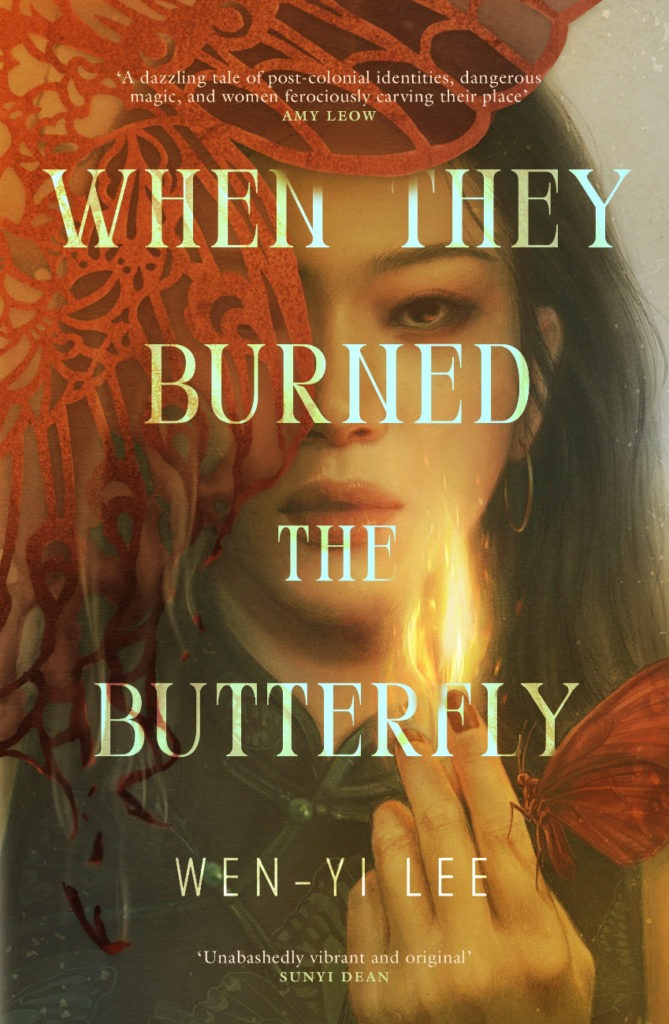
Your sophomore book takes us to 1970s Singapore with a girl gang navigating secret societies. What inspired you to tell this story?
I was sent a TikTok video about a real girl gang in Singapore called Red Butterfly, that existed in the 50s and 60s, and the idea sank its hooks into me. I'm always fascinated by powerful women in unexpected places in history, and the name Red Butterfly is such a fiction writer's gift. It immediately made me start thinking about fire, and crucibles, and metamorphosis.
And then because I was writing about their coming-of-age, I started thinking about national coming-of-age, too, and setting the girls against this 1970s, newly-independent, post-colonial, nation-building backdrop, with shared anxieties about survival and creating your own identity, and similar rapid transformations.
It did take a lot of research. I'm sure I've become one of the top users of National Library Board's newspaper archive (which is an incredible resource, by the way). Especially because it's a time period in a lot of people's living memory, I had a big need to try and do it justice. I think the most interesting thing that's come out of it is multiple people telling me that their grandma or the grandma of someone they know has a butterfly tattoo! I claim a lot of creative license, though. It's not meant to be an authentic depiction.
What did you want to explore about womanhood and power in that setting?
The primary image of Chinese gangs is so aggressively male. I was really compelled by figuring out what it looks like for a group of girls to navigate, subvert, but also appropriate those power dynamics. There's a layer of the book that's about what femininity and womanhood looks like for different people, especially for queer women, more masculine women, women in different social classes. Adeline is a lesbian who starts out in a girls' school and also gets her powers from her single mother, so it's also what ideas of power, family, and inheritance look like when male structures are completely removed (and if they can ever entirely be).
Singapore is often seen as efficient and safe, but your fiction reveals darker, haunted textures. Are you rewriting the city’s image?
I hope so! Singapore has such a reputation for being sterile that I’ve found it quite invigorating—maybe aspirational—to focus on grit and guts, as well as characters outside of the mainstream fabric. I think Butterfly was also unconsciously my own process of reconnection and renegotiation with home and the country’s narratives after coming back from studying overseas. Trying to grasp onto a sense of fire, as it were. Our history and our communities aren’t passionless; a great number of people have always been out there fighting. Maybe the better answer is that I’m trying to remind those, like past me, who need reminding.
What do you think readers will be most surprised by in this book?
In Singapore? How overt the queer elements are, maybe, or that they didn’t realise you can write 'Sing Lit' in that way. I’ve come across some books like that—like Amanda Lee Koe’s Ministry of Moral Panic—that actually made me want to write about home, too. In general, I’ve already been getting a lot of pleasant surprise that the main character is so—am I allowed to say bitchy?—strong-willed. She’s kind of a brat, but she’s also deeply traumatised and deeply feeling and deeply angry.
You’re entering publishing so young. How does it feel to discover your voice so publicly?
I don’t think youth should mean imposter syndrome, but it’s definitely chaotic because I’ve been figuring out how to be an adult at the same time, and it can actually feel quite lonely not being able to relate to friends with more conventional jobs. But mainly I think it means that I’m discovering my voice very publicly, instead of getting to solidify it more before putting anything out. I feel very lucky to be in this out the gate (although the US scene, where I’m primarily published, is interesting right now, to say the least).
What does success look like to you at this stage in your life?
The goalposts shift like crazy, but basic success to me is getting to keep doing this writing thing, and getting to put out work at the level that I want to. I’m really in it for as long of a haul as I’m able.
Can you share with aspiring writers what it takes to get published?
Luck is a giant part of it, but I think you also need a good amount of willingness to break the rose glasses and see it as a job. Passion alone, unfortunately, doesn’t go too far. If you want it to be a career then you have to treat it like a career, and that includes putting in the work on your writing as well as understanding the industry and the market. Frankly, I question why I do this, because putting part of your soul on the table like this really isn’t kind to your sanity, especially if you’re also balancing a day job. But other days I really remember that I’m getting to do what I love. I think it’s about finding ways to realign—or at least protect–the joy that made me pursue this path in the first place.
When They Burned The Butterfly will hit bookstores on 21 October 2025. Catch Wen-Yi at her book launch at Book Bar on 1 November 2025, from 2pm-3pm.