

Mounjaro has officially entered Singapore’s weight loss landscape, and it arrives at a moment when Hollywood has already made it part of the public conversation. Over the past couple of years, a number of American celebrities have openly discussed using Mounjaro to help them achieve their ideal weight. Kelly Clarkson has been transparent about using Mounjaro for medical reasons; Meghan Trainor said she and her husband take a low dose without “shame”; Amy Schumer and Adam Lambert (who lost 60 pounds over eight months) switched over to Mounjaro, after leaving Ozempic, citing bad side effects. Others who are said to use it include actresses Whoopi Goldberg, Rosie O’Donnell, and Tori Spelling.
Now that it has become available in Singapore, local interest is growing quickly. But celebrity discussions rarely explain how these medications actually work or who they are meant for. To understand what Mounjaro does, how it differs from other known injectables, and what patients should consider before starting any of them, ELLE spoke to two Singapore-based doctors who prescribe weight-management medications: Dr Sue-Anne Toh of Novi Health and Dr Sue Ho from Prologue Centre for Women’s Wellness.
Related article: Can Ozempic Interfere With Contraception?
HOW IT WORKS

Related article: Why Your Period Might Disappear When You Exercise Too Much
Before decoding Mounjaro, you have to first understand how drugs like Ozempic (or Wegovy, approved for weight management in Singapore) work. Semaglutide, the active ingredient in Ozempic acts on a single hormone receptor called glucagon-like peptide-1 (GLP-1), a natural hormone that helps regulate blood sugar and appetite. As Toh explains, “Imagine GLP-1 as a single key that fits a single lock. It works by telling your brain to feel less hungry and your stomach to empty more slowly, making you feel fuller for longer. It can help your body better regulate insulin levels when you eat.”
Mounjaro, whose name is inspired by Mount Kilimanjaro (which conjures the vision of conquering an arduous climb), was developed by American drugmaker Eli Lilly and Company. Its active ingredient, tirzepatide works double duty as both a GLP-1 and a gastric inhibitory polypeptide (GIP) receptor agonist. Initially created for the treatment of Type 2 diabetes, it has also made it an effective option for weight management. “It’s like a master key that fits two different locks,” adds Toh. “By targeting both pathways, tirzepatide can create a more comprehensive effect on appetite, food intake, and metabolism, which is why it often leads to a greater percentage of weight loss in clinical trials.”
Yet, while tirzepatide has proven to be far more effective for weight loss, further studies are ongoing to assess whether it offers the same degree of heart protection as that of a semaglutide, which has shown significant benefit for patients with a history of heart disease or high cardiovascular risk.
Related article: What Gen Zs Should Be Doing To Future-Proof Their Health
TYPICAL RESULTS

Under medical supervision, many patients who are on Mounjaro can achieve 15 to 20 per cent reductions within a year, which is often higher than the 10 to 15 per cent typically seen with most semaglutide over a similar period. “Individual results can vary greatly,” Toh shares. “Some may lose more, some less, but in those with excess weight, a 5 per cent weight loss is still clinically significant for improving health markers.”
Plateaus in weight loss can also be expected. “We talk about them as a ‘new normal’ for the body and a sign that it is adapting,” explains Toh. Managing this often requires lifestyle adjustments, including diet, increased physical activity, and sometimes changes in dosage.
Both doctors caution against assuming Mounjaro is automatically the “best” drug. “I would shift the conversation from ‘which is better’ to ‘which is better for you’,” Toh says. As with any medical establishment in Singapore, before patients are considered for weight loss or diabetes management, they will have to undergo comprehensive medical assessments and a full health screening. “We look at someone’s health background and current condition, goals, lifestyle, and factor in cost considerations,” she adds.
Toh also screens for mental health concerns. “We assess for eating disorders, which may make these medications inappropriate. It’s not just about what the patient wants; it’s about what’s safe, sustainable and effective for that individual.”
SIDE EFFECTS

Side effects are common across all GLP-1 medications and tend to appear more frequently during the early stages or when dosing increases. The usual symptoms include nausea, reflux, constipation and fatigue. “To manage this, we start with the lowest dose and increase gradually,” says Ho. She also advises patients to eat smaller meals, avoid high-fat foods and stay hydrated while adjusting.
Concerns about hair shedding have also become common on social media, but both doctors clarify that this is not caused directly by GLP-1 medications. “This can occur with rapid weight loss from any method, not just these medications,” Toh says.
Another widely discussed issue is the fear of looking gaunt, often referred to as “Ozempic face.” Both doctors agree that facial volume loss is linked to the speed of weight loss rather than the medication itself. Resistance training, balanced nutrition and adequate protein intake, and gradual weight reduction can reduce this risk. “We encourage a healthy rate of weight loss, typically 0.5-1 kg per week, to minimise the aesthetic side effects of rapid fat loss,” says Toh.
COST CONSIDERATIONS
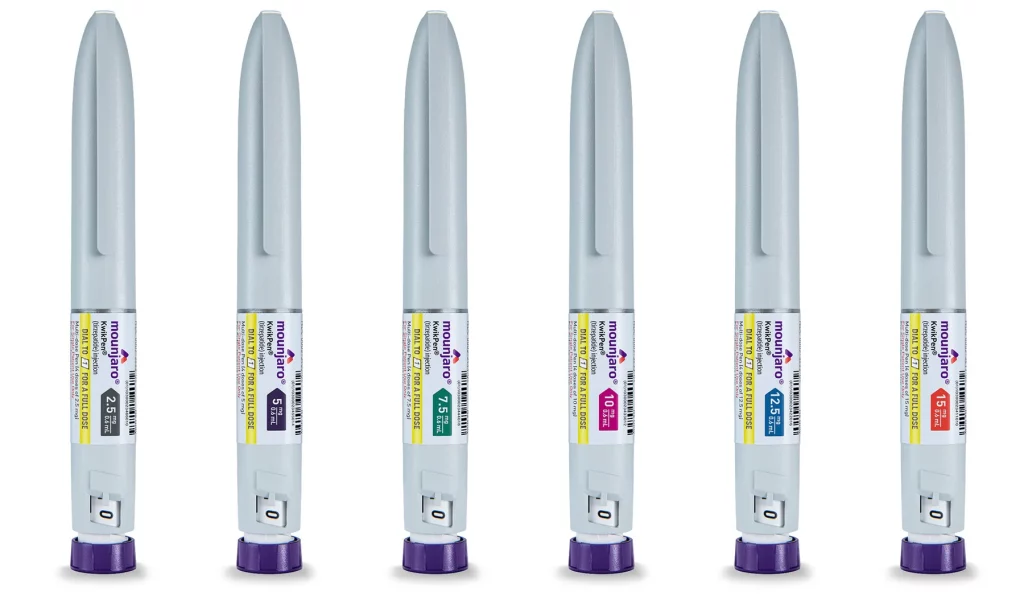
Cost is a significant factor for many patients. In Singapore, GLP-1 based treatments like Saxenda (a daily injection) and Wegovy typically range from $400 to $700 per month depending on dose. Mounjaro, being newer, is typically around $1,000 a month for the higher dose tiers. Most patients pay out of pocket (as insurance doesn’t cover medications for weight loss), and monthly expenses can increase further with consultations and lab tests.
Long-term management is another important part of the discussion. “Just as a patient with hypertension may need medication indefinitely, some patients may need to stay on a maintenance dose to prevent weight regain,” says Toh. “However, a safe step-down is possible for some, especially those who have successfully integrated sustainable lifestyle habits and achieved an optimal body composition.”
For anyone considering Mounjaro, both doctors offer the same advice: The medication can be highly effective for the right patient, but it is not a shortcut or trend to follow. The decision should be based on health needs, long-term goals and a full understanding of cost, commitment and medical suitability. “These drugs should be served as a tool to aid the process of weight loss and not as a replacement for lifestyle changes,” advises Ho.