
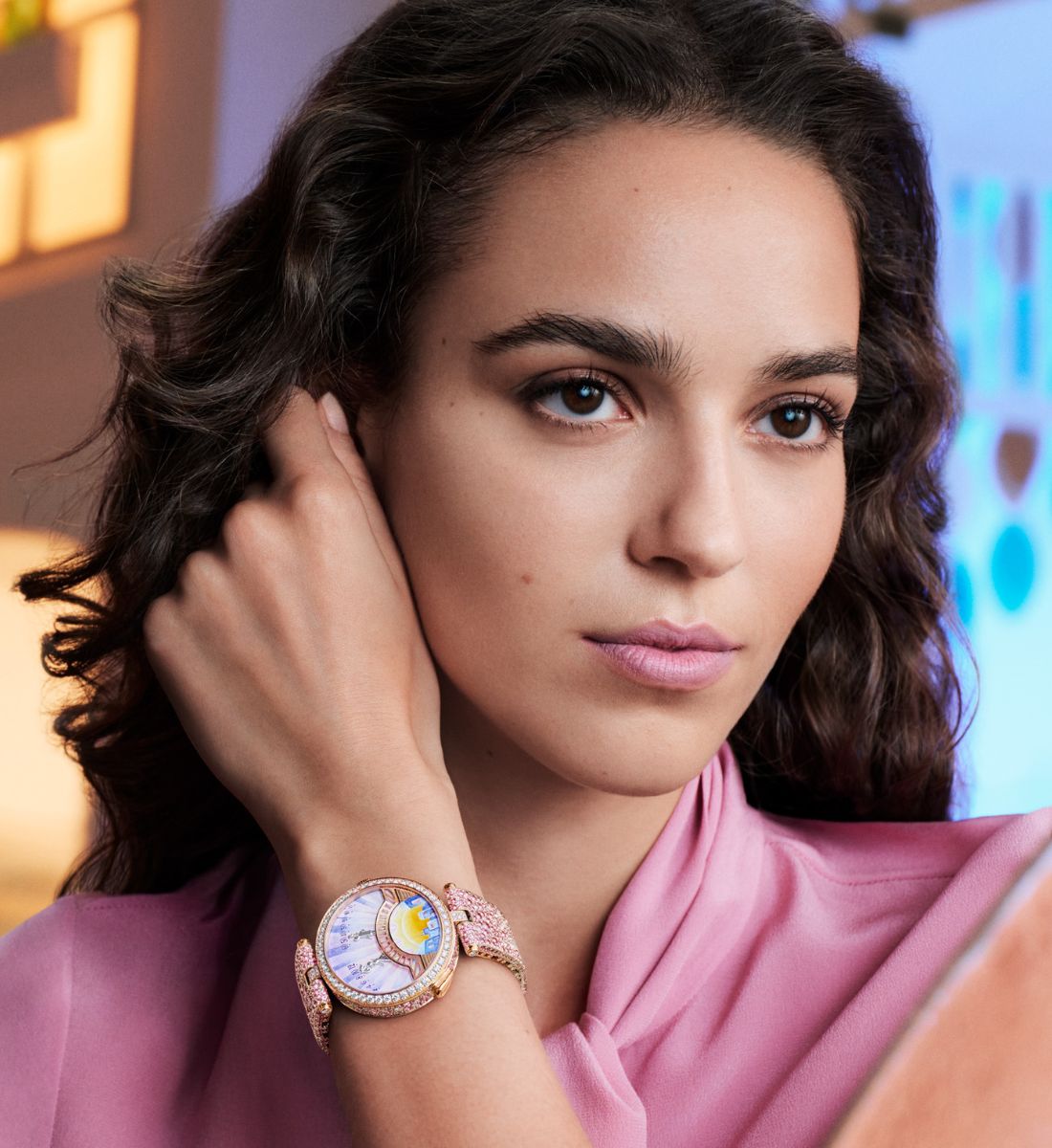
Few Maisons have made emotion as central a pillar to their watchmaking universe as Van Cleef & Arpels has. Born from a real-life romance that united two families of jewellers at the start of the 20th century, the Maison has, for over a century, woven love, poetry and wonder into jewels that happen to tell the time. Nowhere is this more eloquently expressed than in its Poetic Complication timepieces that promise narrative and artistry as much as they do mechanical ingenuity.
The Pont des Amoureux watch, introduced in 2010, for example, established Van Cleef & Arpels as a master storyteller. The retrograde dial display shows a lovers’ rendezvous on a bridge, with the man and woman—the minute and hour markers—meeting at the top of the bridge.
Related article: Women Are The New ‘Watch Guys’
Over the years, this scene with the automaton, or animated figures, has been depicted through a spectrum of colours, backdrops and techniques but its emotional message has remained unchanged.
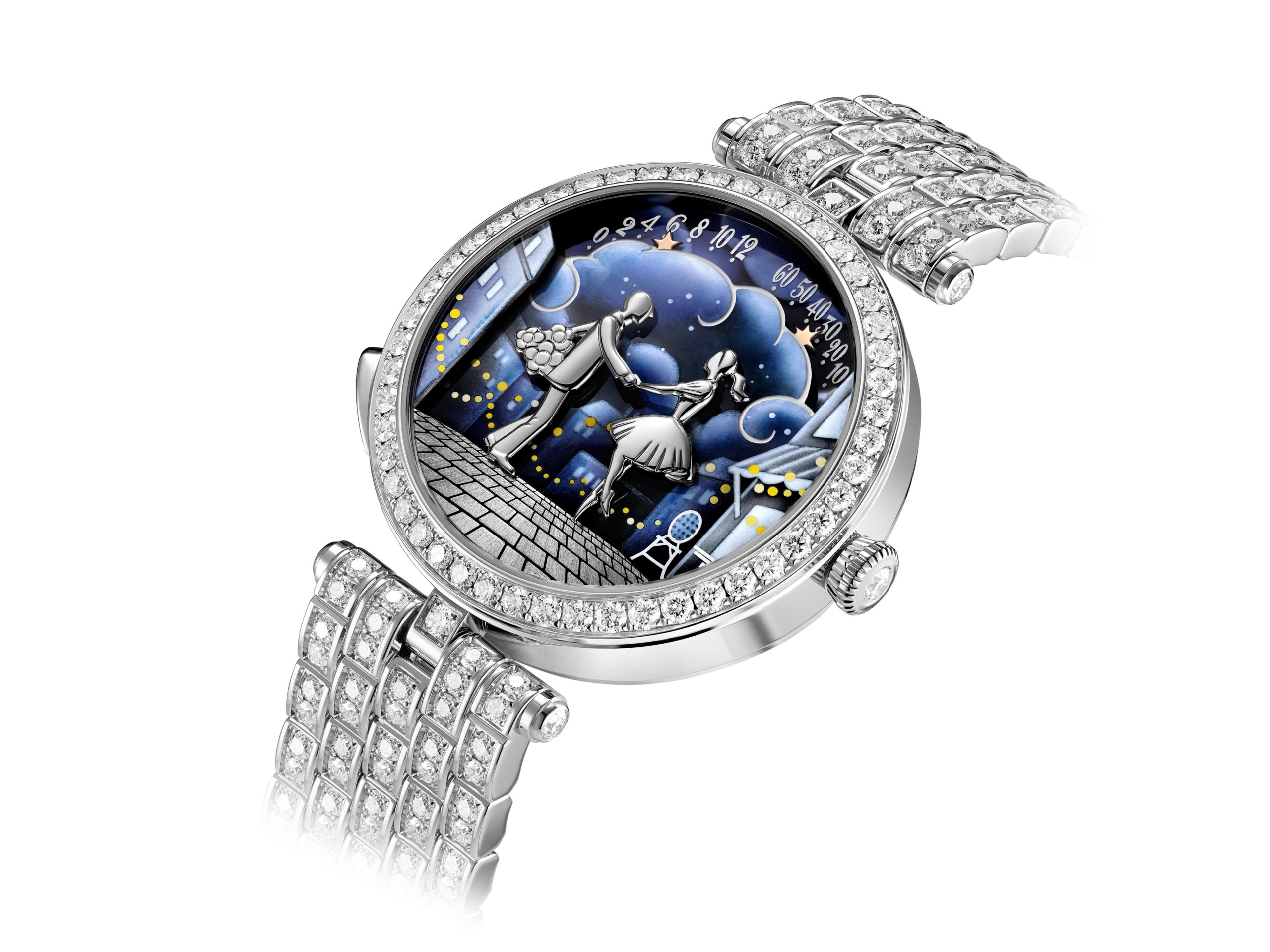
In 2025, the new timepiece in this collection, the Lady Arpels Bal des Amoureux Automate timepiece, has relocated the setting from a Parisian bridge to an al fresco dance café under a starlit sky of grisaille enamel. Four years of intensive research and development has gone into this horological marvel, with engineers and artisans working hand in hand to create a sophisticated automaton movement. Three patents lie beneath the layers of métiers d’art—the specialised craftsmanship—to make the gestures feel natural and emotionally resonant.
It is in this delicate balance of engineering and enchantment that Van Cleef & Arpels’ watchmaking philosophy truly reveals itself. Rainer Bernard, Head of Research and Development for Watchmaking, offers an insight into how such miniature worlds are imagined and engineered—so that every kiss, pivot and pause takes place with poetry and romance.
Related article: Van Cleef & Arpels' Treasure Island High Jewellery Collection Promises Fun, Whimsy and Gems in Spades
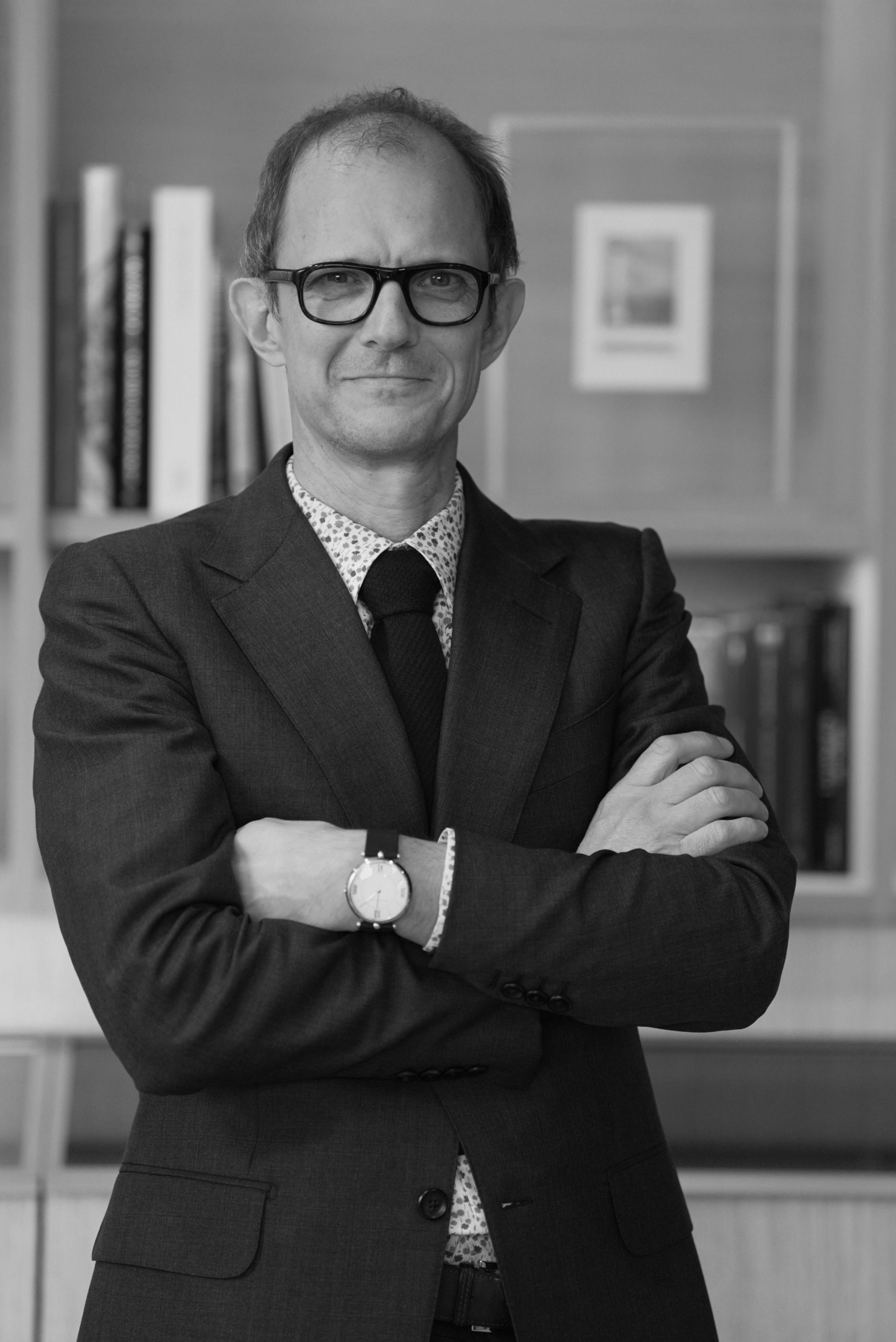
There is arguably no other Maison in the world today that is as much a storyteller as Van Cleef & Arpels is, with your recent focus being your famous lovers once more. Can you tell us more about that?
Well, we like love stories; the company is founded on a love story. Love stories have always been part of our creations: We have the Lady Arpels Bal Des Amoureux Automate, four new Lady Arpels Pont Des Amoureux, and the Naissance de l’Amour automaton, whose name translates to the birth of love. For our lovers, we envisioned them in a different setting—a guinguette, which is a French bar or cafe where you can sit outside, and where people go to enjoy themselves, to talk, to see others. It’s a very cosy, happy atmosphere. And that’s where the story begins for the Bal Des Amoureux Automate.
It’s not just the setting that has changed. The lovers themselves perform a different kind of movement from what we’ve seen on the previous Pont Des Amoureux watches.
Now the stars indicate the time, and when the stars meet at 12 o’clock, this is the moment where our lovers [move together to] lean over for a kiss. And we’ve made the kiss last for three minutes because this is a good French kiss. And then, both stars go down, and the lovers return to their initial position. We have also integrated kissing on demand in this watch—with an unlimited number of kisses—which means you can activate it as often as you want.
How is this managed in terms of energy consumption?
In the Pont Des Amoureux, both the double retrograde and the automaton mechanisms are driven at the same time. For the Bal Des Amoureux Automate, the automaton mechanism is on top of the retrograde system. When the stars align, we have the kiss, but when you press [the watch for the kiss] on demand, it moves just the automaton, and not the stars. We have a patent on this, which enables us to have a design that is not very thick. The second patent is on the synchronisation of the double retrograde and our automaton. The third and final patent is on how the lovers move. We found a way to move and rotate both lovers with only one single cam [component that modifies motions].
Related article: In Conversation With Van Cleef & Arpels President and CEO Nicolas Bos
I understand that despite this, the new movement only required four more components than that of the Pont des Amoureux!
We try to design it as cleverly and as simply as possible; complexity is not an objective. I compare it to writing. A novice writer may take two pages to write about something that an experienced writer takes half a page to say, and yet you understand it better. This is the same in engineering. We spent quite a long time defining the architecture of the movement because it determines what you will actually develop. It was very important for us to integrate it with the metiers d’art. We had to give the lovers some degree of liberty. They hold hands so we had to have one point of [articulation] in the shoulder and one in the hip for them to pivot. Did you see that she lifts her leg? That took us quite a while to get that motion perfectly natural and smooth, and to find the right speed. We have a centrifugal regulator that controls the speed. Centrifugal regulators are normally used for minute repeaters but we built our own in order to regulate that poetic speed.
The first time that I saw the lovers move, I thought that it was such an ingenious concept. You have the lady pivot so that her hands go down and her leg kicks out. But the controlled manner in which she does it? That’s where the finesse lies. Much like the Lady Arpels Heures Florales watch, where the flowers burst open before closing again in a controlled manner.
So much engineering that has gone into that; so much testing, calculation and engineering of the power consumption. And we’ve done it as simply and effectively as possible. The movement has 343 components, which is not a small number. It’s quite complex, but for what it is and does, I think it’s a good number. Having a double retrograde indicator is tricky because you have two hands moving in a space that you can’t use for the rest of the [watch’s] movement. But we wanted the stars to move this way.
And it’s obvious that you are still excited about the results.
For me and the whole team, it’s not just the creation but the path that is important. We’ve worked together on it for four years. We’ve had so many discussions on so many things. We make decisions that brought the idea forward. There are many things to take into account. The movement is completely in the background. In the foreground, we have the craftsmanship with the handmade dial and the handset stones. You have seen the final product but not the process. The process is actually what’s interesting, and it comes with a lot of positive vibrations. We’re a funny team, and we laugh a lot. Nobody is more important than the other. So, I think that when you look at the watch, you can see that positive vibrations that were there during the creative process. Personally, I think that’s awesome.