
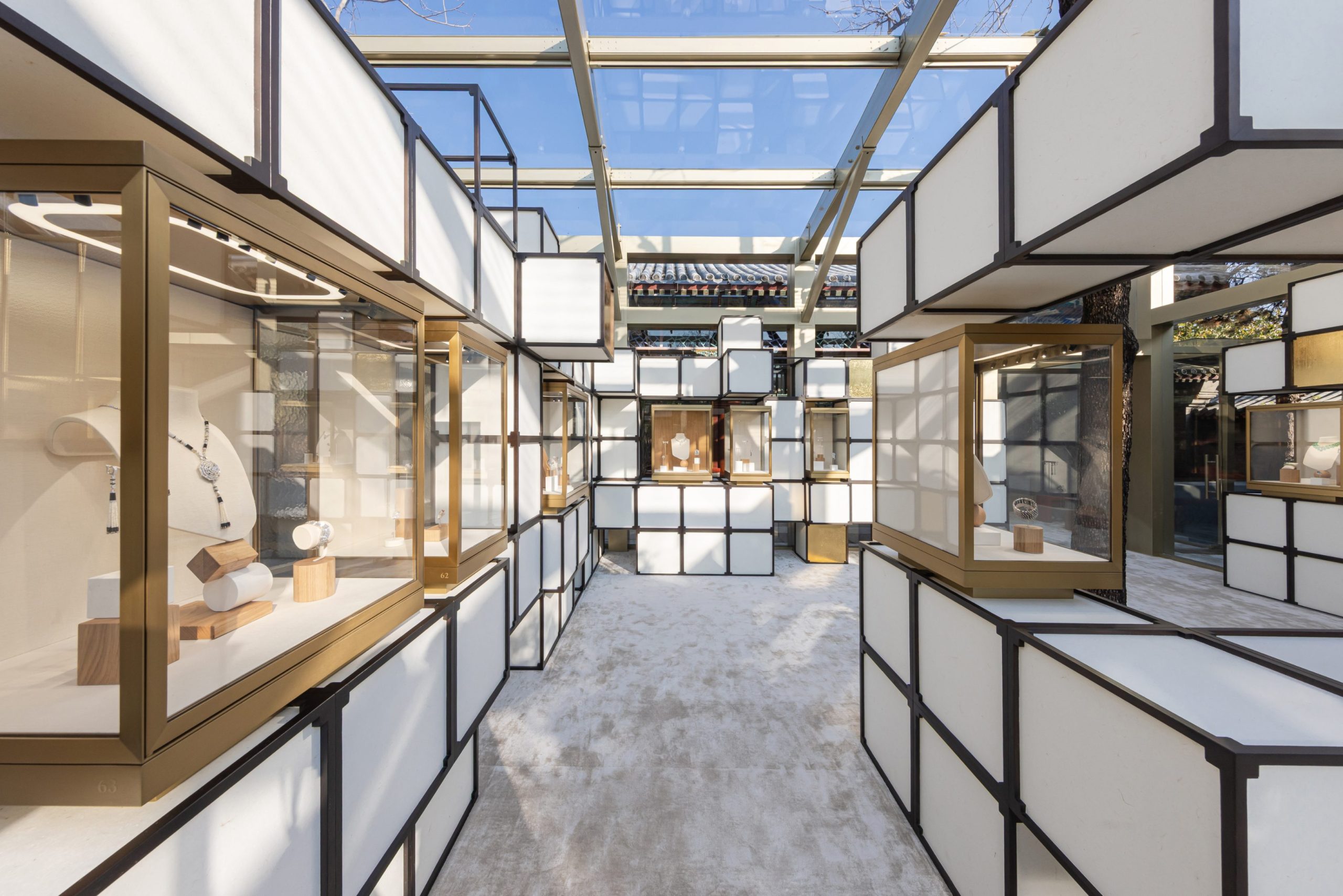
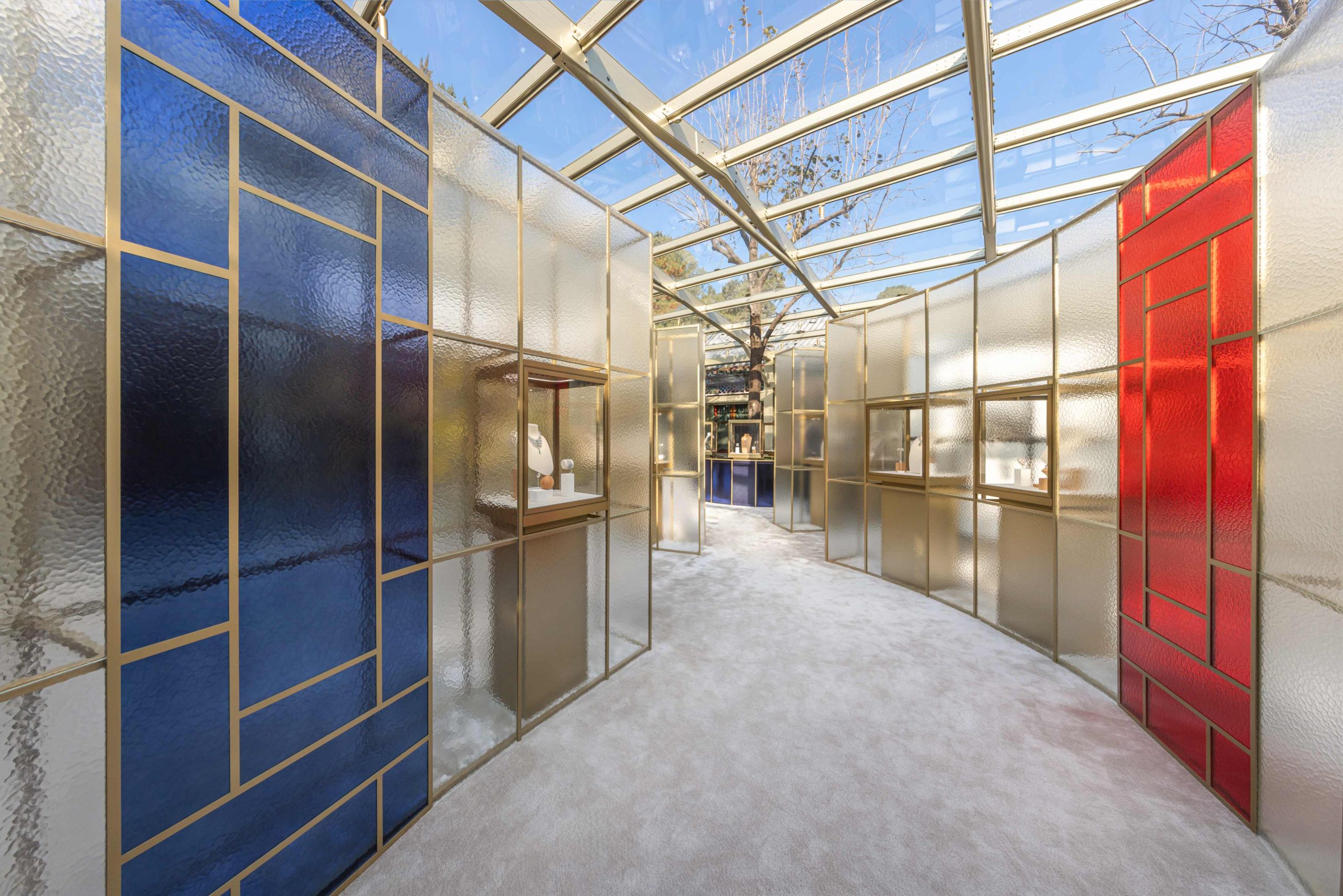
We are in the century-old imperial gardens of the Aman Summer Palace resort in Beijing, which has been transformed into a modernist jewellery box of sorts. A see-through marquee has been set up to let in natural light while keeping out the cold, as trees frame the venue with their lush greenery. We are here for the unveiling of the second chapter of Cartier’s En Équilibre high jewellery collection. The venue, with its marriage of the man-made and the natural, provides the perfect setting for a collection that is an exercise in equilibrium: Lightness and volume, opulence and restraint, precision and poetry have all been calibrated with Cartier’s exacting sense of proportion.
Comprising over 480 creations spanning high jewellery, fine watchmaking, and high jewellery watches, the exhibition is assembled around three themes: Colours, Rhythm and Volume. Each presents balance as a tension between opposing forces—a notion that is more easily written about than it is to create.
Related article: Cartier Crafts Bespoke Rosary For Wes Anderson’s The Phoenician Scheme
As Cartier’s Director of the High Jewellery Workshops, Alexa Abitbol notes, every stage of the high jewellery process, from sketch to reality, presents its own unique set of challenges. “Each step is crucial and impacts the next craft. For instance, the designer has a vision, an emotion, a story to tell through the jewel. The sculptor has to capture this soul and ensure it is not lost in the technical transition. It is particularly the case for Cartier’s bestiary where the sculptor has to emphasise the emotion that the animal must express; to capture the animal’s psyche, its character, its movement, and even its gaze, in order to breathe soul into the material.”
This ethos comes to splendid life in the Najaatra necklace in the shape of a majestic blue cobra that coils sensuously around the neck while guarding the 51-carat aquamarine cabochon at its front. Aptly placed within the Volume chapter, the necklace took Cartier’s master craftsmen close to 3,000 hours of work to produce. No small number of those hours went towards the uniquely shaped scales and their meticulous setting of over 2,000 stones comprising tourmalines, aquamarines and diamonds.
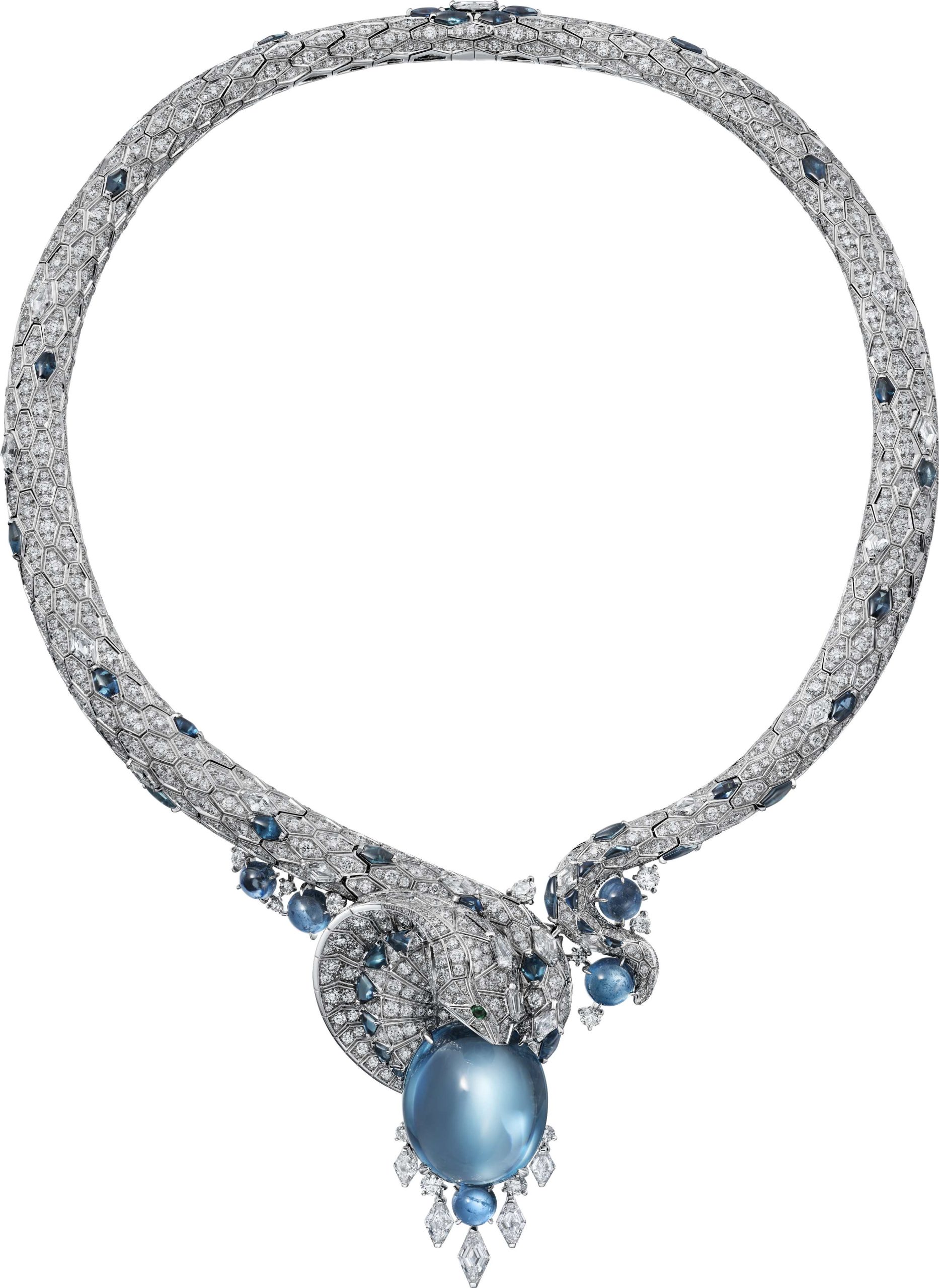
“The Najaatra necklace showcases our unique craftsmanship,” Abitbol says. “Its dynamism is palpable in the elegant movement of its tail and the orientation of its face, which reveals every detail and optimally showcases the central stone. Each scale is meticulously designed to create a compelling sense of perceived movement and perspective, before the precise layout of tourmalines and diamonds was applied. The collaboration between the polisher and the stone setter was crucial.”
This dialogue between craftsmen is a recurring theme throughout En Équilibre. While the initial drawing provides a clear roadmap, the final form is often shaped through exchange. As Abitbol tells me, “In some cases, after having spent hundreds of hours on a piece, the artisans may face some technical constraints, or imagine better technical details that inspire a more creative solution for a piece. This two-way conversation is key to creating the bridge between the creative vision and the physical reality.”
Related article: Creative Director Marie-Laure Cérède Delves Into Cartier's Haute Joaillerie Timepieces
As we move on to Rhythm, the showcase’s second theme, Cartier’s sculptural language makes way for visual repetition and structure. The Vetrata necklace, for example, draws inspiration from Art Deco skyscrapers and guides the wandering gaze along its monochromatic form. An 8.15-carat rectangular-cut diamond takes pride of place, alongside 20 similar diamonds punctuated with onyx accents, in a symmetrical design that blends rigid geometry with surprising flexibility for comfort.
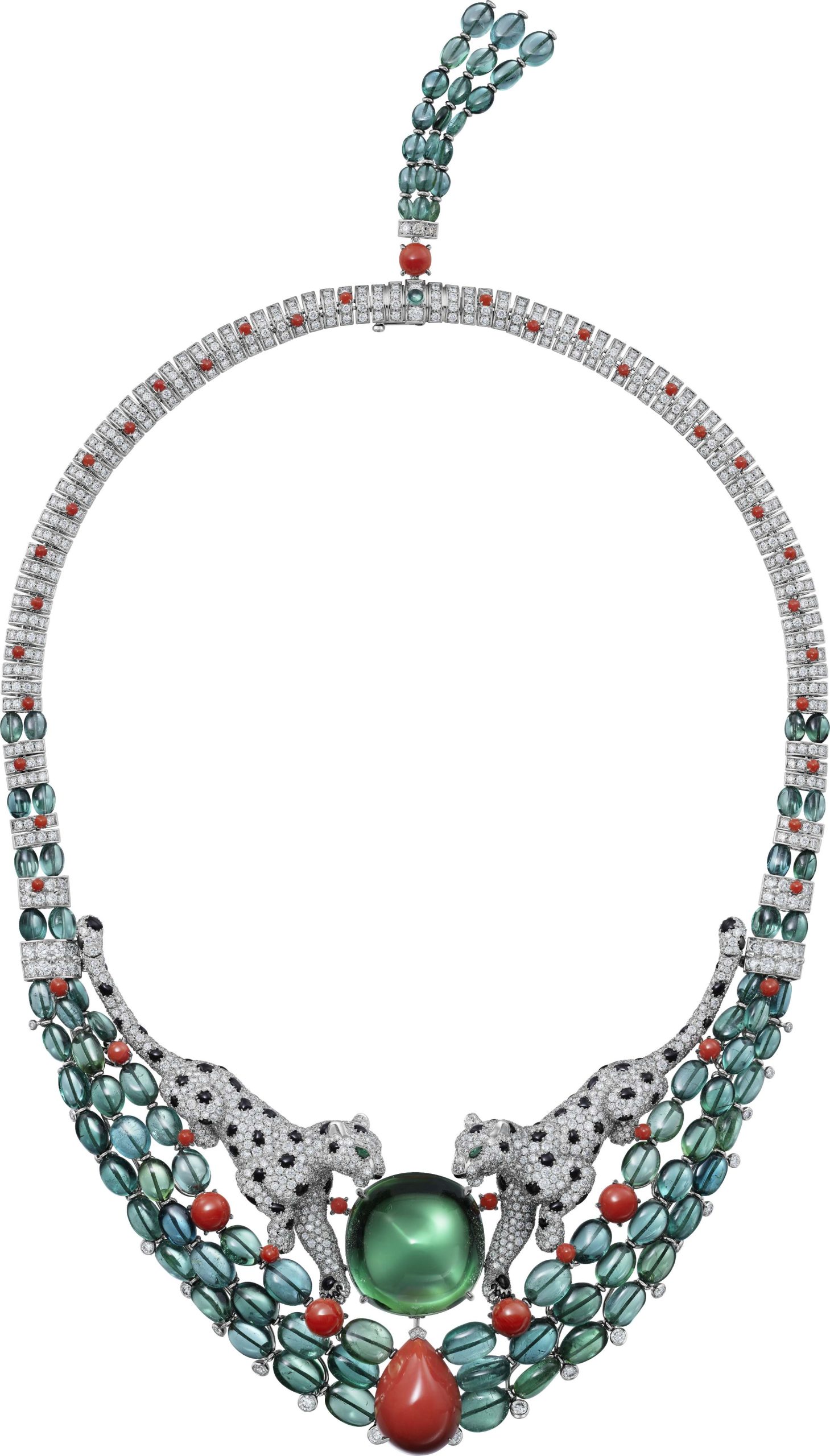
In the Panthères Reflexio necklace, Cartier’s emblematic feline appears twice, mirrored in a languid pose that showcases its naturalistic, muscled body. “The sculpture [of the panther] is not just a form, but a living presence, charged with palpable emotion that tells a story and evokes a deep connection with the observer,” Abitbol notes. Here, they frame a 74.10-carat green tourmaline and a 14.91-carat red coral for a colour pairing that has remained a Cartier hallmark for over a century.
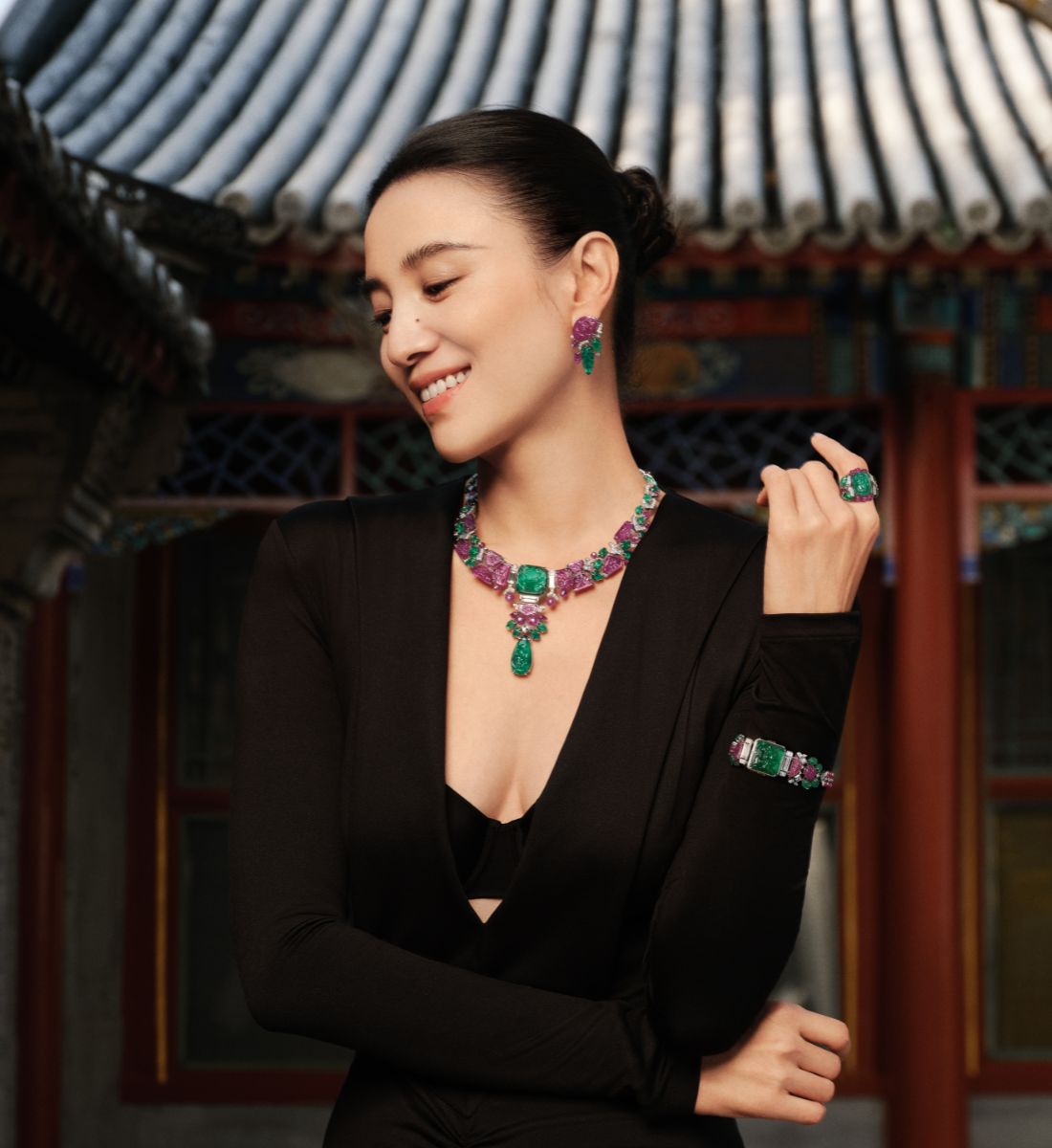
In the third and final theme of Colour, we see an impressive spectrum of shades laying the foundations for creations of chromatic intensity. Cartier’s iconic Tutti Frutti returns in the Tutti Ta Prohm necklace with a botanical theme inspired by the ancient Ta Prohm temple in Cambodia. Carved rubies, emeralds and sapphires—cut in baroque forms—interlock around central emeralds to create a composition that feels exuberant yet disciplined.
The Byzas necklace presents a restrained counterpoint with a blue-green pairing—often referred to as the Maison’s peacock pattern—from a 11.70-carat pear-shaped Ceylon sapphire and eight Zambian emeralds that weigh in at 9.31 carats. These intensely coloured gems are set on an openwork diamond frame whose geometric patterns introduce a gentle visual rhythm.
Related article: Inside The Whimsical Cartier Nature Sauvage Exhibition
“At Cartier, every high jewellery piece begins with the stone, which inspires our designers to sketch our future pieces,” Abitbol says. “Once the design is approved, our workshops receive it to begin production. This stage is long and can take months, or even years, depending on the complexity of the pieces. Sculptors will work on the three-dimensional volume, and once this is validated by the designer, it will be handed over to the jeweller who will start a kind of ballet with the other crafts, sometimes as many as 10, until the unique piece is completed.”
Taken as a whole, En Équilibre is less a display of virtuosity than a study in restraint. “Our pieces remain light to the eye,” Abitbol reflects. “The simplicity of complexity. Hence the notion of Équilibre.” Perfect harmony is achieved when everything falls precisely in place.